How we make money: Some links on this page are affiliate links, marked “Sponsored.” If you buy through one, we may earn a commission. It doesn’t change what we write. This article is general information, not medical advice.
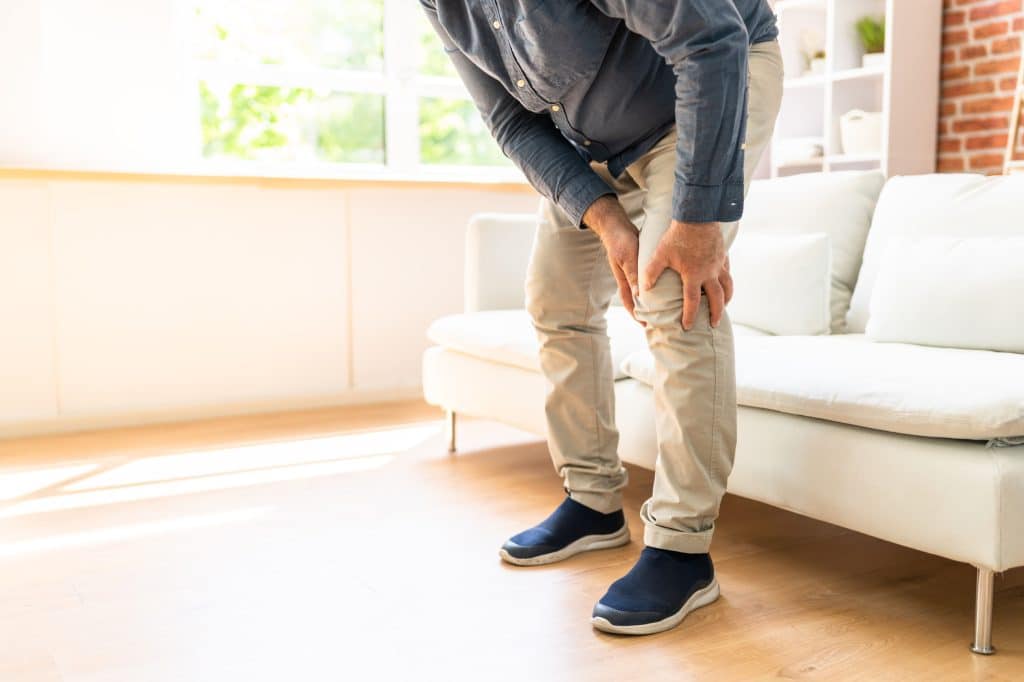
Knee pain is common at every age. It can start suddenly after an injury or a workout, or begin as a mild ache that slowly gets worse.[1] Most of the time you can treat it at home with rest and over-the-counter pain relief, but some knee problems need a doctor to take a look.[2]
This guide covers the usual causes, the home care that helps, the treatments with the best evidence for knee arthritis, and the warning signs to act on. If several joints hurt, start with our joint pain relief guide instead.
In brief
- For a new, mild knee ache, rest the knee, use ice and an elastic sleeve, and take an over-the-counter pain reliever as the label directs.[1]
- For knee osteoarthritis, exercise and weight loss (if you carry extra weight) are the non-drug treatments the American College of Rheumatology recommends most strongly.[3]
- Call your doctor if you can’t put weight on the knee, you have a fever, redness, warmth or a lot of swelling around the knee, or the pain hasn’t eased after 3 days of home care.[1]
What usually causes knee pain
Your knee is where your thighbone meets your shinbone. It’s the biggest joint in your body and carries a lot of your weight, which is one reason it gets injured so often. Most knee pain comes from arthritis, an injury or overuse.[2]
Sponsored · Joint supplement
Building a daily routine for your knees?
Joint Genesis is a daily joint supplement from BioDynamix. See exactly what’s in it, and today’s price, on the official site.
Official site · opens in a new tab
Injuries
- Torn ligament. An anterior cruciate ligament (ACL) tear can happen when you stop and change direction quickly, land badly from a jump, or take a hard hit to the side of the knee. It’s common in basketball, football, soccer and skiing.[4]
- Torn meniscus. A tear in the rubbery cartilage inside the knee. The pain is usually on the inside or outside of the joint.[1]
- Sprains. Minor ligament injuries from a sudden or awkward twist.[1]
Overuse
- Bursitis. Swelling of the small fluid-filled sacs around the knee, often from repeated pressure such as kneeling for a long time.[1]
- Tendinitis. Inflammation of a tendon, often after a change in activity or from overuse.[1]
Arthritis
- Osteoarthritis is the most common joint disorder. The cartilage that cushions the joint breaks down and wears away, causing pain, swelling and stiffness.[5]
- Rheumatoid arthritis is an autoimmune disease, where the immune system attacks healthy joint tissue. It usually affects the same joints on both sides of the body.[6]
- Gout happens when uric acid crystals form in a joint. The pain starts suddenly, often at night, and the big toe, knee and ankle are hit most often.[7]
- Calcium pyrophosphate arthritis (once called pseudogout) is caused by a different type of crystal. The knee is one of the joints it affects most.[8]
Extra body weight raises your risk of knee problems.[1] An old knee injury and sports with hard impact or twisting make osteoarthritis more likely later in life.[5]
Knee pain relief at home
If your knee pain has just started and isn’t severe, these steps usually come first. If it started with an accident or injury, contact your provider.[1]
Rest and raise a sore knee
Rest the knee, avoid the activities that make it hurt, and keep it raised when you can to bring down swelling. An elastic bandage or sleeve from the pharmacy may also help with swelling and support.[1] If you have osteoarthritis, don’t stay still for too long: staying active helps keep the joint moving.[5]
Ice or heat?
- Ice is the better choice for a fresh injury or a gout flare.[9] For new knee pain, MedlinePlus suggests ice for up to 15 minutes every hour on the first day, then at least 4 times a day after that. Put a towel between the ice and your skin, and don’t fall asleep with ice on.[1]
- Heat often feels better for long-term osteoarthritis because it helps loosen stiff joints.[9] Keep each session under 20 minutes, and take a heating pad off if it gets uncomfortably warm.[9]
Over-the-counter pain relief
- For knee osteoarthritis, the ACR strongly recommends both anti-inflammatory gels (topical NSAIDs, such as diclofenac gel) and NSAID tablets, and suggests trying the gels first.[3]
- Ibuprofen or naproxen tablets ease pain and swelling. Acetaminophen eases pain but not swelling.[1]
- NSAID tablets such as ibuprofen can raise the risk of heart attack, stroke and stomach bleeding, and the risk is higher at high doses or with long-term use.[10] Talk to your provider before taking any of these if you have a medical condition, or if you’ve needed them for more than a day or two.[1]
Canes and braces
If knee osteoarthritis makes walking hard, the ACR advises a cane or other mobility aid, and it conditionally recommends knee braces.[3] Ask your doctor or physical therapist which type suits your knee, and see our guide to brace types.
Exercise: the treatment with the best evidence
Exercise and weight loss are the only two non-drug treatments the ACR strongly recommends for knee osteoarthritis.[3] Stronger muscles around the knee take stress off the joint and help it absorb shock.[11]
Three moves from the AAOS Knee Conditioning Program
The American Academy of Orthopaedic Surgeons (AAOS) publishes a free Knee Conditioning Program. Warm up first with 5 to 10 minutes of easy walking or a stationary bike. Then do the program’s stretches, and repeat them when you finish. You should not feel pain during any exercise.[11]
- Leg extensions. Sit up straight on a chair. Tighten your thigh and slowly straighten one leg as high as you can. Hold for 5 seconds, then lower your foot to the floor. Do 3 sets of 10, 4 to 5 days a week.[11]
- Hamstring curls. Hold the back of a chair for balance. Bend one knee and lift your heel toward the ceiling as far as you can without pain. Hold for 5 seconds, then relax. Do 3 sets of 10, 4 to 5 days a week.[11]
- Straight-leg raises. Lie on the floor, propped on your elbows. Bend one knee with that foot flat. Tighten the thigh of your straight leg and lift it 6 to 10 inches. Hold for 5 seconds, then lower it. Do 3 sets of 10, 4 to 5 days a week.[11]
AAOS suggests following the program for 4 to 6 weeks, then doing it 2 to 3 days a week to keep your strength. It also says to do it under your doctor’s supervision, so check with your doctor or physical therapist which moves suit you.[11]
Low-impact activity
Cycling and swimming are easier on the knee than running, and water exercise is often helpful for osteoarthritis.[1][5] Tai chi and yoga each get a conditional recommendation from the ACR for knee osteoarthritis.[3]
When to see a physical therapist
The ACR says doctors should refer people with osteoarthritis to physical therapy when pain, fatigue or limited movement gets in the way of exercise or daily life.[3] A physical therapist can help you build strength and flexibility around the knee, which takes pressure off the joint.[2]
Sponsored · Joint supplement
Adding a supplement to your routine?
Joint Genesis is a daily joint supplement worth a look if you’re building a joint-care routine. See the full ingredient list before you buy.
Weight loss and knee osteoarthritis
If you have overweight or obesity, the ACR strongly recommends weight loss for knee osteoarthritis.[3] Small amounts add up. In a study of 142 older adults with knee osteoarthritis and overweight or obesity, each pound lost was linked to about 4 pounds less load on the knee with every step.[12]
The 2026 ACR update also adds a new conditional recommendation for GLP-1 medicines in people with knee osteoarthritis and obesity, used with diet and exercise to help reach a healthy weight.[3] Ask your doctor whether that applies to you.
What about joint supplements?
There are plenty of joint supplements on the shelf, but the best-known ingredients have weak evidence. The ACR strongly recommends against glucosamine, chondroitin and products that combine them for knee osteoarthritis.[3] The FDA also doesn’t approve dietary supplements for safety or effectiveness before they’re sold.[13]
If you decide to try one, check it with your doctor or pharmacist first, especially if you take other medicines.
Treatments a doctor may offer
If home care and exercise aren’t enough, a doctor can look for the cause. You may need an X-ray, MRI or CT scan, or a sample of fluid from the knee.[1] Depending on what they find, options include:
- Other medicines. For knee osteoarthritis, the ACR conditionally recommends duloxetine, a prescription medicine, and topical capsaicin.[3]
- Steroid injections. The ACR strongly recommends steroid (glucocorticoid) injections for knee osteoarthritis. Trials show they work in the short term.[3][14]
- Hyaluronic acid injections. The ACR conditionally recommends against them for knee osteoarthritis.[3] Read more in hyaluronan for joint pain.
- Platelet-rich plasma (PRP) and stem cell injections. The ACR strongly recommends against both for knee osteoarthritis.[3]
- Surgery. Most people with knee pain won’t need it. It may be an option for a torn ligament or a broken bone, and a knee replacement may be suggested for arthritis that still causes severe pain after other treatments.[2]
Our joint injections guide explains what each type of injection involves.
Natural remedies people try
- Castor oil packs. A traditional home remedy. The one human trial gave castor oil as capsules by mouth, not as a pack, and a Cochrane review judged the results to favor the comparison painkiller, diclofenac.[15][16] See castor oil for knee pain for how people use it and the safety checks.
- Acupuncture. The ACR conditionally recommends it for knee osteoarthritis.[3]
- Massage. The 2026 ACR update conditionally recommends massage therapy for knee osteoarthritis. That’s a change from 2019, when the ACR advised against it.[3][14]
When to see a doctor
Contact your doctor if:[1]
- you can’t put weight on your knee
- the pain is severe, even when you’re not standing on it
- your knee buckles, clicks or locks
- your knee looks deformed or misshapen
- you can’t bend your knee, or can’t straighten it all the way
- you have a fever, redness or warmth around the knee, or a lot of swelling
- you have pain, swelling, numbness, tingling or bluish skin in the calf below the sore knee
- you still have pain after 3 days of home care
Go to the emergency room or call 911 after a serious injury such as a car accident or a bad fall, or if you can’t move your knee or leg, or think you’ve broken a bone.[2]
Common questions
Is kneeling bad for your knees?
Kneeling for long periods is linked to knee problems. Repeated pressure from kneeling can lead to bursitis, and jobs that involve kneeling or squatting for more than an hour a day raise the risk of osteoarthritis.[1][5] If kneeling hurts, ask a physical therapist about other ways to do the task.
Is walking good for knee pain?
For knee osteoarthritis, yes in most cases. Walking is the form of aerobic exercise studied most in osteoarthritis, and exercise is strongly recommended.[3][14] Staying active also helps keep the joint moving.[5] To go easier on your knees, walk down hills rather than running them.[1] Ease off if walking makes the pain worse.
Why does my knee hurt more in the morning or at night?
Many people feel more knee pain first thing in the morning, or at night after an active day.[2] With osteoarthritis, morning stiffness usually lasts 30 minutes or less.[5] Morning stiffness that lasts more than an hour is common in rheumatoid arthritis, so mention it to your doctor.[6]
Should I worry if my knee clicks or pops?
A grating or crackling sound when you move the knee can happen with osteoarthritis.[5] See your provider if the knee buckles, clicks or locks, or if you heard a pop when you hurt it, since a “popping” sound is an early sign of an ACL tear.[1][4]
Sponsored · Joint supplement
Ready to try Joint Genesis?
Check today’s price on the official BioDynamix site.
Official site · opens in a new tab
Free · From APM Health
Get our morning movement routine
A short routine for easing stiff knees into the day. Sign up now and we’ll email it as soon as it’s ready.
- Free
- Sent as soon as it’s ready
- One email a week at most
Unsubscribe any time. Privacy policy
How we checked this article
Medical review: pending. A clinician hasn’t reviewed this article yet. We last checked it against the sources below on November 3, 2026.
Sources
- MedlinePlus. Knee pain. Reviewed November 7, 2024.
- Cleveland Clinic. Knee pain. Updated July 20, 2025.
- American College of Rheumatology. 2026 Update of the ACR Recommendations for the Management of Osteoarthritis of the Knee, Hip, and Hand. Summary approved September 8, 2026; posted September 14, 2026.
- MedlinePlus. Anterior cruciate ligament (ACL) injury.
- MedlinePlus. Osteoarthritis.
- MedlinePlus. Rheumatoid arthritis.
- MedlinePlus. Gout.
- MedlinePlus. Calcium pyrophosphate arthritis.
- Cleveland Clinic. Ice vs. heat: which is better for your pain? February 5, 2025.
- MedlinePlus. Ibuprofen.
- American Academy of Orthopaedic Surgeons, OrthoInfo. Knee Conditioning Program.
- Messier SP, Gutekunst DJ, Davis C, DeVita P. Weight loss reduces knee-joint loads in overweight and obese older adults with knee osteoarthritis. Arthritis & Rheumatism. 2005;52(7):2026-2032. PubMed 15986358
- US Food and Drug Administration. FDA 101: Dietary supplements. Content current as of June 2, 2022.
- Kolasinski SL, Neogi T, Hochberg MC, et al. 2019 American College of Rheumatology/Arthritis Foundation Guideline for the Management of Osteoarthritis of the Hand, Hip, and Knee. Arthritis Care & Research. 2020;72(2):149-162. Full text
- Medhi B, Kishore K, Singh U, Seth SD. Comparative clinical trial of castor oil and diclofenac sodium in patients with osteoarthritis. Phytotherapy Research. 2009;23(10):1469-1473. PubMed 19288533
- Cameron M, Chrubasik S. Oral herbal therapies for treating osteoarthritis. Cochrane Database of Systematic Reviews. 2014;(5):CD002947. Full text