How we make money: Some links on this page are affiliate links, marked “Sponsored.” If you buy through one, we may earn a commission. It doesn’t change what we write. This article is general information, not medical advice.
A spinal cord stimulator is a small implanted device that sends a mild electric current to the spinal cord to ease long-lasting pain.[1][2] It’s usually considered only after other treatments, such as medicines, exercise and physical therapy, haven’t worked.[1][2] Below: how it works, the trial and implant, the side effects, and what placebo-controlled trials found.
In brief
- You usually try a temporary stimulator first, and a permanent one is usually implanted only if the trial helps, which typically means your pain is cut by at least half.[2][3]
- Side effects and risks include infection, leads that move or break, device faults, spinal fluid leaks and further surgery. In one placebo-controlled trial, 18% of people had an adverse event and 8% needed surgery to fix the system.[1][2][4]
- NICE recommends stimulation for some long-term nerve pain. A 2023 Cochrane review found it probably doesn’t improve low back pain compared with placebo at 6 months, and 10 of the 13 trials it included had financial ties to device makers.[3][5]
What is a spinal cord stimulator?
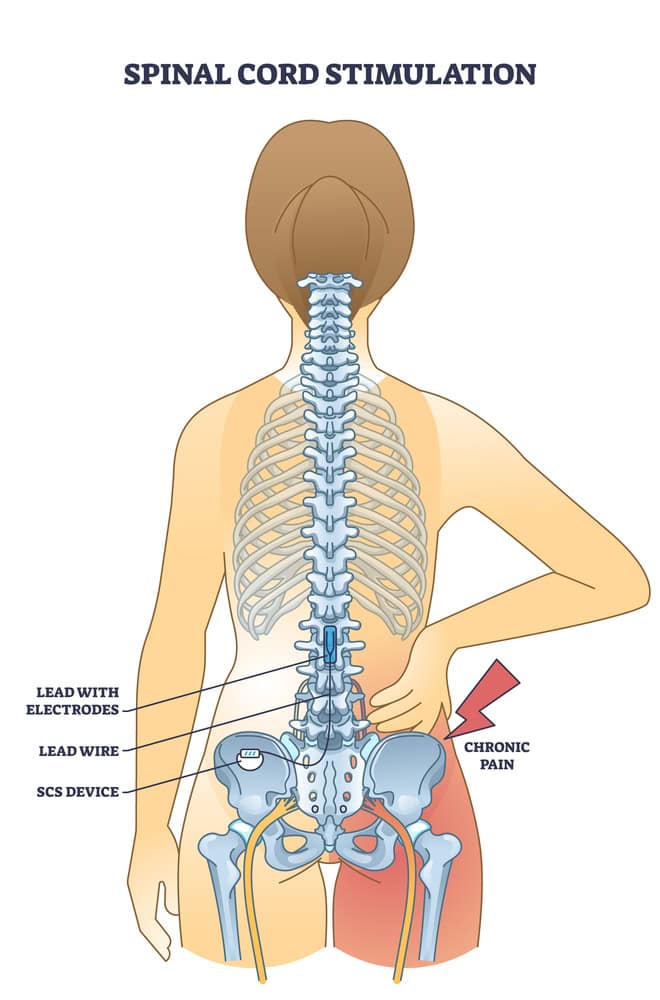
Spinal cord stimulation (SCS) uses a mild electric current to block nerve impulses in the spine.[1] Pain signals start in your nerves and travel along the spinal cord to your brain. A stimulator sends a separate electrical current into the spinal cord that can block chronic pain signals and help your brain ignore them. Cleveland Clinic compares it to a white noise machine: it doesn’t get rid of the pain signals, but it can help you tune them out.[2] MedlinePlus notes that it doesn’t cure back pain or treat the source of the pain.[1] You may also see it called a neurostimulator, neuromodulation or dorsal column stimulation.[1]
The parts of the system
A typical stimulator system has four parts:[3]
- A neurostimulator, sometimes called the generator, which makes the electrical pulses. It’s implanted under the skin of the abdomen or buttock area.
- One or more electrodes placed near the spinal cord.
- A lead that connects the electrodes to the neurostimulator.
- A remote control to turn the neurostimulator on or off and change the level of stimulation.
Some neurostimulators have a non-rechargeable battery, some have a rechargeable one, and some receive power from an external device.[3] Figures for battery life differ. MedlinePlus says non-rechargeable batteries last 2 to 5 years and need another operation to replace. Cleveland Clinic says most last at least 10 years, and that with a rechargeable model you hold a charger near your skin.[1][2] NICE notes that how long a system lasts depends on your pain pattern and how much stimulation you need.[3]
Who is a spinal cord stimulator for?
Doctors usually suggest nonsurgical treatments such as physical therapy and medicines first. A stimulator may be an option if those haven’t worked, or if it isn’t safe for you to take certain medicines, such as opioids.[2] MedlinePlus lists these reasons a surgeon may recommend it:[1]
- back pain that continues or gets worse, even after treatment to correct it, which may include surgery
- complex regional pain syndrome (CRPS)
- long-term back pain, with or without arm or leg pain
- nerve pain or numbness in the arms or legs
- inflammation of the lining of the brain and spinal cord
Cleveland Clinic adds others, including diabetes-related neuropathy, phantom limb pain, pain after shingles (postherpetic neuralgia), spinal cord injuries, persistent spinal pain after laminectomy (a type of spine surgery), and angina. It notes that researchers are still studying other uses.[2]
What NICE recommends
NICE, the UK’s National Institute for Health and Care Excellence, recommends spinal cord stimulation as an option for adults with chronic nerve (neuropathic) pain who have had pain of at least 50 on a 0 to 100 scale for at least 6 months despite appropriate standard medical care, and who have had a successful trial of stimulation. It should only be offered after an assessment by a multidisciplinary team experienced in chronic pain and in looking after people with these devices.[3] Unlike Cleveland Clinic’s list, NICE does not recommend it for pain caused by reduced blood flow (ischemic pain), such as angina or critical limb ischemia, except as part of a clinical trial. The guidance was published in 2008 and last reviewed in 2014.[3]
Tests before surgery
Before surgery you’ll usually need a physical exam, blood tests and imaging, such as a spine X-ray or an MRI. Tell your care team about every medicine and supplement you take, because you may need to stop some of them.[2] MedlinePlus says you may be asked to stop blood thinners, including some over-the-counter painkillers and supplements, in the week before surgery, and that smoking can slow healing.[1]
The spinal cord stimulator trial
Getting a stimulator is a two-step process. First, you try a temporary one.[2] For the trial:[1][2]
- Your back is numbed. Some people have general anesthesia instead, which puts you to sleep.
- The surgeon makes a cut in the skin, usually in the middle of your back.
- Thin wires (leads) go into the epidural space, between the spinal cord and the bones of the spine.
- The leads are connected to a small generator outside your body. It may be stitched or glued to your skin.
- The current is adjusted to the kind of pain you have.
MedlinePlus says the procedure takes about 1 to 2 hours, and you can go home once the leads are in place.[1] You wear the external generator for the whole trial and use a remote to control it. You can’t get the leads or generator wet, so avoid swimming, hot tubs and baths, and ask your surgeon whether you can shower.[2] Cleveland Clinic says surgeons usually suggest trying it for a few weeks, and that a successful trial usually means the stimulator reduces your pain by at least half.[2]
The trial lets you feel what stimulation is like and gives an idea of how much relief to expect. But specialists told NICE that trial results can mislead both ways: some people have a successful trial and then don’t benefit from the permanent implant, and some have an unsuccessful trial but might have benefited. A trial also means extra hospital visits and may increase the risk of side effects such as infection.[3]
Getting the permanent implant

If the trial manages your pain and you’re comfortable using the device, the permanent stimulator is implanted a few weeks later.[1][2] You may have general anesthesia, so you’re asleep, or anesthesia that numbs your back.[1][2] Cleveland Clinic describes these steps:[2]
- The surgeon makes a cut in your back in the same place as for the trial.
- The permanent leads are put in. Most people get two, some only one.
- The leads are threaded under your skin to where the generator will sit.
- The generator is implanted, usually near the top of one buttock.
- The stimulator is switched on and programmed, and checked before the cuts are closed.
Nothing is left outside your body. The generator is a few inches long and about half an inch thick, and you may be able to choose which side it goes on, so tell your surgeon if you usually sleep on one side.[2] MedlinePlus says the operation takes about 30 to 45 minutes and that the generator can go under the skin of the abdomen or buttocks.[1]
After the operation
Most people go home the same day, though your surgeon may want you to stay overnight.[1] Before you leave, you’ll be shown how to care for the cuts and how to use the remote. You’ll usually keep the surgery sites clean and change the bandages for around a week.[1][2] While you heal, avoid heavy lifting, bending and twisting. Light exercise such as walking can help.[1] Cleveland Clinic also lists stretching, exercise and other intense physical activity as things to avoid, and says your surgeon will give you a weight limit and tell you when it’s safe to get back to your usual routine.[2]
Cleveland Clinic says you’ll need four to six weeks after the permanent implant to get used to the leads and their effects while your body heals around them. A follow-up visit about two weeks after surgery is used to take out stitches or staples, and later visits help you adjust to the stimulation.[2]
Living with a spinal cord stimulator
Once you’ve healed, you should be able to get back to many of your usual activities.[2] A few things to keep in mind:
- MRI scans. Cleveland Clinic says it isn’t safe to have an MRI with most stimulators, and MedlinePlus says you may not be able to have one after the implant. Discuss this with your surgeon, and always tell anyone arranging a scan or other imaging test that you have a stimulator.[1][2]
- Other medical devices. A stimulator may interfere with devices such as pacemakers and defibrillators.[1]
- Security checks. You’ll set off metal detectors at airports, concerts and arenas. They won’t affect how the stimulator works, but you may need to tell security staff about your device.[2]
- Driving and machinery. Turn the stimulator off before driving, operating machinery or using power tools. It’s very rare, but if it malfunctions you could lose control of your body.[2]
- Settings and follow-up. The stimulator can be adjusted depending on how you respond.[1] NICE says people with a stimulator need ongoing care, including round-the-clock access to help with potentially serious problems.[3]
Spinal cord stimulator side effects and risks
All surgery has risks. MedlinePlus and Cleveland Clinic list most of these for spinal cord stimulators, and trial data add others:[1][2]
- Infection at the battery or electrode site. If this happens, the hardware usually needs to be removed.[1][2]
- Leads that move, break or stop working, which may mean more surgery.[1][2]
- Device faults, such as a signal that’s too strong, too weak or stops and starts, or a generator that fails.[1][2]
- A spinal fluid leak and headaches. Cerebrospinal fluid can leak when the needle or leads go in. Cleveland Clinic says these headaches typically get better on their own in a week or two.[1][2]
- Nerve damage to the nerves that leave the spine, which can cause weakness, paralysis or pain that doesn’t go away. Cleveland Clinic says spinal cord injury from the surgery or from a broken lead is rare.[1][2]
- A collection of blood or fluid between the dura, the covering of the brain, and the surface of the brain.[1]
- Bladder problems, in 1 of 50 people in a placebo-controlled trial.[4][5]
- Pain after surgery, and tingling or numbness when the stimulator is on.[1][2]
- Pain that comes back or isn’t helped. The stimulator may not work, pain can return once your body adjusts to it, and stimulators sometimes lose effectiveness over time for unknown reasons.[1][2]
How often problems happen
Figures vary by study. In a placebo-controlled trial of 50 people in Norway, 9 (18%) had an adverse event and 4 (8%) needed surgery to revise the implanted system. The most common was an accidental opening of the dura, the covering of the spinal cord, during lead placement, in 3 people. None of the adverse events was life-threatening.[4] The 2023 Cochrane review found that adverse events were poorly reported in trials that added stimulation to medical care. Across those trials, 11.7% to 30.9% of people with an implant who were followed for up to 2 years needed revision surgery because of adverse events.[5] A study of US insurance records found that 17.9% of 1,260 people with a stimulator had a stimulator-related complication within 2 years, and 22.1% had the device revised or removed, though not always because of a complication.[6] NICE notes that further surgery may be needed because of failed parts, lead position or infection, or when the battery runs down.[3]
When to get medical help
After a stimulator trial or implant, go to the ER if you have:[2]
- a headache that’s constant when you stand or sit up but goes away when you lie down, which can be a sign of a spinal fluid leak
- signs of infection around the surgery sites, such as discoloration, swelling, pain, or an oozing or bad-smelling discharge
- sudden numbness, tingling or muscle weakness on one or both sides of your body anywhere below the leads, which may mean a lead has moved
Some tingling is normal with certain stimulators. Ask your surgeon which sensations to expect and which are warning signs.[2]
Call 911 or go to the ER if you have back pain and:[7]
- pain, tingling, weakness or numbness in both legs
- loss of feeling around your genitals or anus
- changes in your bladder or bowels, such as trouble urinating or losing control of your bladder or bowels
- changes in how your penis or vagina feels during sex, or trouble getting an erection or reaching orgasm
- chest pain
- pain that started after a serious accident, such as a car crash
Don’t drive yourself to the ER. Ask someone to drive you, or call 911.[7]
Call your doctor right away or go to urgent care the same day if you have back pain and:[7]
- you feel hot, cold, shivery or generally unwell
- the pain is severe and started suddenly, or it’s getting worse quickly
Does spinal cord stimulation work? What the research shows
NICE’s recommendation rests mainly on two trials in people with failed back surgery syndrome, where back or leg pain continues after spine surgery, and one trial in people with CRPS. All three compared stimulation with other care, not with a placebo.[3] In one of the back surgery trials, called PROCESS, 48% of people who had stimulation added to their usual medical care had at least 50% pain relief at 6 months, compared with 9% of those who had medical care alone. At 12 months the figures were 34% and 7%.[3] In the CRPS trial, stimulation plus physical therapy reduced pain more than physical therapy alone at 6 months and 2 years, but the difference wasn’t significant at 5 years in the main analysis. In a smaller analysis of only the people who received an implant, the 5-year difference fell just short of statistical significance, though NICE’s committee read it as supporting a lasting benefit. It accepted there was some uncertainty about how long effects last, but concluded that benefits could be sustained for at least up to 5 years in nerve pain.[3]
The PROCESS trial was funded by a device manufacturer. The Cochrane reviewers point out that the medical care in it wasn’t standardized, which makes its effect hard to interpret, and that a later manufacturer-funded trial didn’t repeat its large effect on leg pain.[5]
The 2023 Cochrane review looked at 13 trials with 699 people with chronic low back pain. None measured low back pain against a placebo for longer than 6 months. At 6 months, the only placebo-controlled evidence came from one trial of 50 people, and it showed that stimulation probably doesn’t improve back or leg pain, function or quality of life (moderate-certainty evidence). For trials that added stimulation to medical care, the reviewers were uncertain about pain because the evidence was very low certainty. Low-certainty evidence suggested it may slightly improve function. All three of those add-on trials were funded by device manufacturers. They concluded that the data don’t support using stimulation for low back pain outside a clinical trial, and that it probably doesn’t have lasting benefits that outweigh its costs and risks.[5] Six of the 13 trials were funded by manufacturers and four more had investigators with financial ties to them.[5]
One trial in that review, which the reviewers found appeared independent of industry funding, was run at a Norwegian university hospital and funded by a regional research body.[4][5] It included 50 people with long-lasting leg pain (radicular pain) after lumbar spine surgery. Only people whose leg pain improved during a 2-week test had a stimulator implanted. They then went through 3-month periods of burst stimulation, one type of stimulation, and of placebo stimulation, in random order. Disability scores improved by similar amounts in both: 10.6 points with stimulation and 9.3 points with placebo on a 0 to 100 scale, a difference that wasn’t statistically significant.[4] The Cochrane reviewers lowered their confidence in this evidence one level because other types of stimulation might work differently.[5] A later post hoc follow-up of 34 participants, 6 months after the trial, when people could adjust their own settings and switch between burst and standard stimulation, found disability scores no better than during the placebo periods of the trial.[8] The authors said the trial shows a strong placebo effect with treatments like this, and that their results don’t support using stimulation for this kind of pain outside clinical trials.[4][8]
Outside trials, the US insurance study compared 1,260 people who had a stimulator with matched people who had conventional medical care. In the first year, people with stimulators were less likely to have spinal steroid injections, radiofrequency ablation or spine surgery. In the second year, those differences had gone. Their care cost over $39,000 more in the first year. The study measured the treatments people used, not their pain scores.[6]
The main studies at a glance
| Study | What it found |
|---|---|
| PROCESS trial: stimulation added to medical care vs medical care alone, back or leg pain after spine surgery, funded by a manufacturer | 48% vs 9% had at least 50% pain relief at 6 months, and 34% vs 7% at 12 months.[3][5] |
| Cochrane review, 2023: 13 trials, 699 people with chronic low back pain, 10 with ties to manufacturers | Probably no better than placebo at 6 months. Pain benefit very uncertain when added to medical care.[5] |
| Placebo-controlled trial: 50 people with radicular pain after spine surgery, no industry funding reported | No significant difference in disability compared with placebo.[4][8] |
| US insurance records: 1,260 people with a stimulator vs matched people without | Fewer injections and spine surgeries in year 1, but no difference in year 2. 17.9% had a complication within 2 years.[6] |
Day to day with chronic back pain
A stimulator, if you have one, is only one part of managing long-term pain. If you’ve had a trial or implant recently, follow your surgeon’s advice on activity first.[2] NICE’s guidance notes, alongside the British Pain Society’s advice, that stimulation isn’t suitable for everyone with chronic pain and should be used only as part of a team approach, alongside other therapies and a plan for rehabilitation.[3] For back pain in general, the NHS advises staying active and keeping up your daily activities, not staying in bed for long periods, and trying exercises and stretches, stopping if your pain gets worse. Walking, swimming, yoga and pilates may also help, and a heat pack wrapped in a towel can ease stiffness or muscle spasms.[7] The NHS also lists cognitive behavioral therapy (CBT) to help you cope with back pain that isn’t getting better.[7]
For more, see our guides to back pain, yoga for back pain and sleeping with chronic pain. For pain that comes from the sacroiliac joint, see our guides to SI joint injections and SI joint fusion.
Sponsored · Back pain program
Keeping your lower back moving day to day?
The Back Pain Breakthrough is a set of short follow-along videos of gentle lower back moves from physical therapist Dr. Steve Young, DPT. Watch on any device.
Common questions
What is the success rate of a spinal cord stimulator?
There’s no single figure. Cleveland Clinic says it depends on the condition being treated and how severe the pain is to begin with, and that most people experience half as much pain.[2] In the manufacturer-funded PROCESS trial, fewer than half of people with a stimulator had at least 50% pain relief at 6 months, and about a third at 12 months, as the research section above explains.[3][5]
Can a spinal cord stimulator be removed?
Yes. NICE describes stimulation as minimally invasive and reversible.[3] In the Norwegian placebo-controlled trial, 4 people had their stimulator removed after the follow-up period because they felt no effect and found the implant uncomfortable.[8]
Can my body reject a spinal cord stimulator?
Cleveland Clinic says these devices aren’t like an organ transplant, which can be rejected when the immune system attacks it. It advises talking to your surgeon if you have any new or changing pain around the implants.[2]
Will I still need pain medicine?
Maybe, but the evidence is mixed. Cleveland Clinic and MedlinePlus say a stimulator may let you take less pain medicine.[1][2] In the PROCESS trial, opioid use didn’t differ significantly between people with a stimulator and those without.[3] The Cochrane review found low-certainty evidence, from 2 manufacturer-funded trials, that adding stimulation to medical care may slightly reduce opioid use.[5] In the US insurance study, people with stimulators were slightly more likely to be on long-term opioids in the first year, with no significant difference in the second.[6]
Sponsored · Back pain program
Lower back moves on video, from a physical therapist
Get instant access to The Back Pain Breakthrough, a gentle at-home video routine from Dr. Steve Young, DPT, and see today’s price on the official site.
Official site · opens in a new tab
Free · From APM Health
Get our free morning movement routine
A short, gentle routine for loosening a stiff back at the start of the day. Sign up now and we’ll email it as soon as it’s ready.
- Free
- Sent as soon as it’s ready
- One email a week at most
Unsubscribe any time. Privacy policy
How we checked this article
Medical review: pending. A clinician hasn’t reviewed this article yet. We last checked it against the sources below on November 7, 2026.
Sources
- MedlinePlus. Spinal cord stimulation. Review date June 27, 2026.
- Cleveland Clinic. Spinal cord stimulator. Last updated December 22, 2025.
- National Institute for Health and Care Excellence (NICE). Spinal cord stimulation for chronic pain of neuropathic or ischaemic origin. Technology appraisal guidance TA159. Published October 22, 2008; last reviewed February 2014.
- Hara S, Andresen H, Solheim O, et al. Effect of spinal cord burst stimulation vs placebo stimulation on disability in patients with chronic radicular pain after lumbar spine surgery: a randomized clinical trial. JAMA. 2022;328(15):1506-1514.
- Traeger AC, Gilbert SE, Harris IA, Maher CG. Spinal cord stimulation for low back pain. Cochrane Database Syst Rev. 2023;3(3):CD014789.
- Dhruva SS, Murillo J, Ameli O, et al. Long-term outcomes in use of opioids, nonpharmacologic pain interventions, and total costs of spinal cord stimulators compared with conventional medical therapy for chronic pain. JAMA Neurol. 2023;80(1):18-29.
- NHS. Back pain. Page last reviewed March 5, 2026.
- Hara S, Andresen H, Solheim O, et al. Six-month follow-up of a trial of spinal cord burst stimulation vs placebo stimulation and disability in patients with chronic radicular pain after lumbar spine surgery. JAMA. 2023;329(22):1985-1986.