
How we make money: Some links on this page are affiliate links, marked “Sponsored.” If you buy through one, we may earn a commission. It doesn’t change what we write. This article is general information, not medical advice.
Sciatica is pain, tingling, numbness or weakness that runs from your lower back down one leg. It happens when the sciatic nerve is irritated or squeezed, most often by a slipped disc.[1][2] It usually gets better in a few weeks to a few months, and the NHS advises keeping active rather than resting.[1]
Gentle yoga is one way to keep moving. This guide covers six beginner poses, with steps and safety cues taken from Cleveland Clinic and the American Academy of Orthopaedic Surgeons (AAOS), and an honest look at what the research shows.
In brief
- Yoga gives small benefits for low back pain, about the same as other back exercise for day-to-day function. Studies of yoga for sciatica itself are few and small.
- Knees-to-chest, cat-cow, child’s pose and bridge are gentle places to start. Stop any pose that hurts or makes your leg pain worse.
- Numbness around your genitals or bottom, or new trouble controlling your bladder or bowels, is an emergency. See the warning signs.
What yoga can and can’t do for sciatica
Most yoga research looks at low back pain in general, not sciatica. A 2022 Cochrane review pooled 21 trials with 2,223 adults who had long-term low back pain. Compared with no exercise, yoga brought small improvements in pain and day-to-day function after three months, but the changes were too small for most people to notice. For day-to-day function, yoga worked about as well as other back exercises; for pain, the comparison is unclear.[3]
The National Center for Complementary and Integrative Health (NCCIH) sums up the research as showing a slight benefit for low back pain.[4] The American College of Physicians lists yoga as one option for chronic low back pain, based on low-quality evidence.[5]
Research on sciatica itself
A PubMed search for yoga and sciatica on November 3, 2026 turned up only small, early studies. In the one randomized trial we found, 61 adults with bulging or slipped discs took a three-month course of yoga classes and home practice, or had usual medical care. About 6 in 10 had sciatica. After three months the yoga group scored lower on a back disability questionnaire, but there was no clear difference in their worst pain. No side effects of yoga were reported.[6]
So yoga is a reasonable way to stay active with sciatica, but it isn’t a proven treatment for it. If it helps you keep moving, that’s a good reason to stick with it.
Evidence at a glance
| Question | What we found | Strength | Source |
|---|---|---|---|
| Does yoga help low back pain? | Small gains in pain and function compared with no exercise, probably too small to notice. About the same as other back exercise for function. | Low to moderate | [3] |
| Does yoga help sciatica? | One small trial: lower disability scores at 3 months, no clear difference in pain. | Low | [6] |
| Do guidelines recommend it? | The American College of Physicians lists yoga as an option for chronic low back pain. | Low | [5] |
| Is it safe? | Side effects, mostly more back pain, were more common than with no exercise and about as common as with other exercise. | Low | [3][4] |
Sponsored · Back pain program
Want a physical therapist to guide each move?
The Back Pain Breakthrough is a set of short follow-along videos from physical therapist Dr. Steve Young, built around gentle moves for lower back pain. You can even do one of them in bed.
Instant access on any device · opens in a new tab
Before you start
- Choose a gentle or beginner class. If you’re new to yoga, skip extreme practices such as headstands, shoulder stands, the lotus position and forceful breathing.[4] In a Mayo Clinic review of yoga injuries, the poses most often to blame bent the spine very far forward or backward.[7]
- Tell your teacher about your back. People with lower spine problems may need to avoid or change some poses, and learning yoga on your own without supervision has been linked with more injuries.[4]
- Be careful with hot yoga. It carries a risk of overheating and dehydration. If you’re pregnant, avoid it, and avoid poses that keep you lying on your back for long periods.[4]
- Let pain be your guide. You shouldn’t feel pain during an exercise.[8] Ease off or stop any pose that makes your leg pain worse.
6 gentle yoga poses for sciatica
These poses match the AAOS spine conditioning program and the sciatica stretches Cleveland Clinic describes.[8][9] Move slowly and only go as far as feels comfortable.
1. Knees-to-chest (Apanasana)
- Lie on your back with your legs straight or your knees bent.
- Bring one knee toward your chest. Hold behind your thigh or over your shin until you feel a gentle stretch.
- Lower the leg and switch sides.[9]
The AAOS version holds each stretch for 5 seconds, then brings both knees in together.[8] You’re after a gentle pull in your lower back, not pain.
2. Cat-cow (Marjaryasana-Bitilasana)
- Start on your hands and knees, with your hands under your shoulders and your knees under your hips.
- Breathe in as you let your belly drop and lift your chest and tailbone (cow).
- Breathe out as you round your back toward the ceiling and tuck your chin (cat).
- Move slowly between the two, one breath for each. Cleveland Clinic suggests 5 to 10 rounds.[10]
Keep your neck long and don’t throw your head back in cow. A cushion under your knees helps if they’re sore.[10] Bending backward can make sciatica worse, especially when spinal stenosis is the cause.[2] If the cow part sends pain down your leg, keep it small or leave it out.
3. Child’s pose (Balasana)
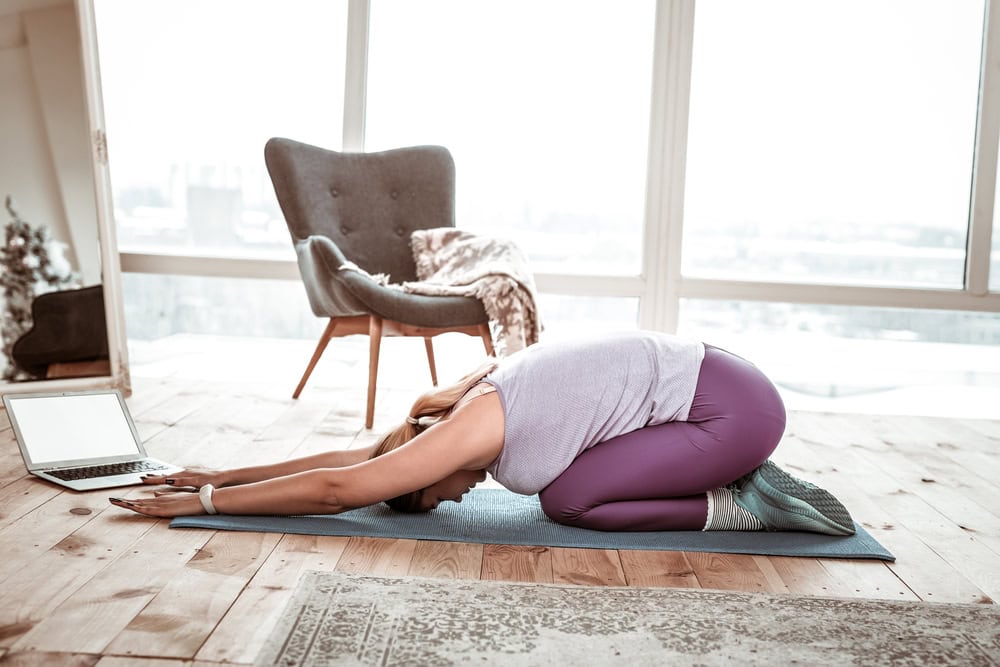
- Kneel with the tops of your feet on the mat, big toes touching and knees about hip-width apart.
- Slowly sit your hips back toward your heels, as far as is comfortable.
- Breathe out and fold forward, bringing your forehead toward the floor.
- Rest your arms by your sides, palms up, or stretch them out in front of you.
- Take long, slow breaths for as long as feels comfortable, then come back up slowly.[11]
Put a pillow or folded blanket under your knees or chest if you need more support, and don’t push through pain. If kneeling is hard, sit on a firm chair and fold forward over your thighs instead.[11]
4. Bridge (Setu Bandhasana)
- Lie on your back with your knees bent and your feet flat on the floor, about hip-width apart.
- Tighten your belly and squeeze your buttocks.
- Lift your hips until your body forms a straight line from your shoulders to your knees.
- Hold for a few seconds, then lower your hips slowly.[9]
The AAOS version holds for 15 seconds. Keep your weight over your shoulder blades and your neck relaxed.[8]
5. Gentle press-up (a soft cobra)
- Lie on your stomach with your hands under your shoulders.
- Keep your hips relaxed on the floor.
- Gently press up to lift your chest, so your lower back arches slightly.
- Slowly lower your chest back down.[9]
This is a backward bend, so keep it small. Skip it if it makes your leg pain worse, especially if you’ve been told you have spinal stenosis.[2]
6. Seated twist (a simple Half Lord of the Fishes)
- Sit on the floor with both legs straight out in front of you, then cross one leg over the other.
- Slowly twist toward your bent leg, with one hand on the floor behind you for support.
- Rest your other arm against the outside of your bent thigh and look over your shoulder.
- Hold, then slowly come back to center and switch sides.[8]
AAOS holds the twist for 30 seconds and suggests sitting tall with both sit bones pressed into the floor.[8] Save this one for later: MedlinePlus advises against twisting your back for the first 6 weeks after sciatica starts.[2]
Poses we left out
Earlier versions of this article also listed pigeon, triangle, downward-facing dog, reclined spinal twist and legs-up-the-wall. We’ve taken them out because we couldn’t find a medical source with safe instructions for them for people with sciatica. A yoga teacher who knows about your back can tell you if and when to try them.
How yoga fits with other sciatica care
Yoga works best as one part of staying active. The NHS recommends carrying on with your normal activities as much as you can, doing regular exercises for sciatica, and using heat packs on the painful areas. Try not to sit or lie down for long periods: even if moving hurts, it isn’t harmful and can help you get better faster.[1]
See a doctor if your sciatica hasn’t improved after a few weeks of home treatment, is getting worse, or is stopping you from doing your normal activities.[1]
A physical therapist can teach you an exercise program and show you how to do it safely.[2][9] For more ideas, see our guides to sciatica exercises and signs your sciatica is healing.
Sponsored Sciatica lasted longer than three months? Take PainApp’s free 2-minute pain test. It’s built on Pain Reprocessing Therapy.
When to get urgent help
Go to the ER or call 911 if you have sciatica and:[1]
- you have it on both sides
- weakness or numbness in both legs is severe or getting worse
- you have numbness around or under your genitals, or around your bottom
- you find it hard to start peeing, can’t pee, or can’t control when you pee, and this isn’t normal for you
- you don’t notice when you need to poop, or can’t control it, and this isn’t normal for you
These can be signs of a serious back problem that needs hospital treatment as soon as possible. Don’t drive yourself.[1]
Call your doctor right away if you have back pain with a fever you can’t explain, pain after a bad fall or blow, or pain that’s worse when you lie down or wakes you at night.[2]
Common questions
What’s the best exercise for sciatica?
There isn’t a single best one. The NHS says anything that gets you moving can help, and Cleveland Clinic suggests low-impact activities such as walking, swimming or yoga.[1][9] The best choice is one you’ll keep doing.
How often should I do yoga for sciatica?
No study has worked out the best schedule for sciatica. In the small trial above, people went to group classes and practiced at home for three months.[6] In the AAOS spine program, most stretches are done daily for 4 to 6 weeks; after recovery, AAOS says 2 to 3 days a week will maintain strength and range of motion.[8]
Can yoga make sciatica worse?
It can. In the Cochrane review, about 43 in 1,000 people doing yoga had a side effect, mostly more back pain, compared with 9 in 1,000 who didn’t exercise. In trials that compared yoga with other back exercise, side effects were about as common in both groups.[3] Ease off or stop any pose that makes your leg pain worse.
Should I do yoga during a flare-up?
Cut back only for the first couple of days, then slowly return to your usual activities. MedlinePlus suggests waiting 2 to 3 weeks before you gradually start exercising again, beginning with light activity such as walking.[12] Starting stretches too soon after an injury can make pain worse, and a physical therapist can tell you when to begin.[12] In the meantime, try not to sit or lie down for long periods.[1]
Sponsored · Back pain program
Ready to roll out your mat tonight?
Follow a physical therapist’s gentle back routine at home. Get instant access to The Back Pain Breakthrough on any device, and see today’s price on the official site.
Official site · opens in a new tab
Free · From APM Health
Get our free morning movement routine
A short, gentle routine for easing a stiff back into the day. Sign up now and we’ll email it as soon as it’s ready.
- Free
- Sent as soon as it’s ready
- One email a week at most
Unsubscribe any time. Privacy policy
How we checked this article
Medical review: pending. A clinician hasn’t reviewed this article yet. We last checked it against the sources below on November 3, 2026.
Sources
- NHS. Sciatica. Page last reviewed December 3, 2024.
- MedlinePlus. Sciatica. Review date August 27, 2024.
- Wieland LS, Skoetz N, Pilkington K, Harbin S, Vempati R, Berman BM. Yoga for chronic non-specific low back pain. Cochrane Database of Systematic Reviews. 2022;11(11):CD010671. PubMed 36398843
- NCCIH. Yoga: Effectiveness and Safety.
- NCCIH. Low-Back Pain and Complementary Health Approaches (summarizes the 2017 American College of Physicians guideline).
- Monro R, Bhardwaj AK, Gupta RK, Telles S, Allen B, Little P. Disc extrusions and bulges in nonspecific low back pain and sciatica: exploratory randomised controlled trial comparing yoga therapy and normal medical treatment. Journal of Back and Musculoskeletal Rehabilitation. 2015;28(2):383-392. PubMed 25271201
- Lee M, Huntoon EA, Sinaki M. Soft tissue and bony injuries attributed to the practice of yoga: a biomechanical analysis and implications for management. Mayo Clinic Proceedings. 2019;94(3):424-431. PubMed 30792066
- AAOS OrthoInfo. Spine Conditioning Program.
- Cleveland Clinic. Sciatica. Last updated February 10, 2026.
- Cleveland Clinic. Cat-Cow Stretch: A Gentle Move With Big Benefits. November 19, 2025.
- Cleveland Clinic. Child’s Pose. February 14, 2025.
- MedlinePlus. Low back pain – acute.