
How we make money: Some links on this page are affiliate links, marked “Sponsored.” If you buy through one, we may earn a commission. It doesn’t change what we write. This article is general information, not medical advice.
Complex regional pain syndrome (CRPS) is a long-term pain condition that usually affects one arm, leg, hand or foot, most often after an injury.[1][2] The pain is out of proportion to the injury that set it off, in how bad it is or how long it lasts.[2][3] CRPS used to be called reflex sympathetic dystrophy (RSD) or causalgia.[4][5]
In brief
- The main CRPS symptom is burning, stabbing or stinging pain in one limb, often with sensitive skin, swelling and changes in skin color, temperature, sweating, or hair and nail growth.[6][7]
- There’s no single test. Doctors diagnose CRPS from your history, symptoms and an exam, after ruling out other causes.[4][8]
- Treatment combines physical and occupational therapy, medicines, psychological support and self-management.[9] Research on every CRPS treatment is limited, and none has high-certainty evidence behind it.[3]
What is complex regional pain syndrome?
CRPS most often affects the hand, though the arms, legs and feet can be affected too.[5]
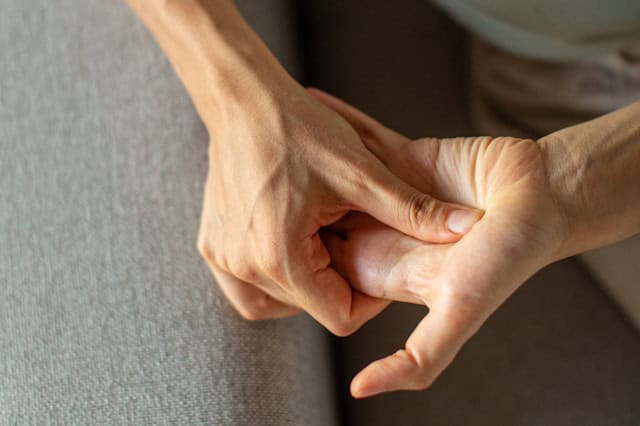
Experts think CRPS comes from a problem in how the nervous system works, in the brain and spinal cord, in the nerves that run out to the limbs, or both. The result is an overreaction to pain signals that the nervous system can’t switch off.[4]
CRPS type 1 and type 2
- Type 1, once known as reflex sympathetic dystrophy, follows an illness or injury that didn’t directly damage the nerves in the affected limb. About 90% of people with CRPS have type 1.[7]
- Type 2, once known as causalgia, follows a distinct nerve injury.[4][7]
The two types have similar signs and symptoms.[7] They share the same diagnostic criteria, and the experts behind those criteria kept the split largely for historical reasons, agreeing it may not change how CRPS is treated.[10]
CRPS symptoms
Pain is the main symptom. It can be severe and constant, and it may feel like a mix of burning, stabbing or stinging, and there may also be tingling and numbness.[6] Cleveland Clinic says the pain is often felt deep inside the affected limb.[4]
CRPS usually starts within about a month of an injury, according to the NHS, or four to six weeks after an injury, fracture or surgery, according to Cleveland Clinic. It can also start without a known cause.[4][11]
Very sensitive skin
The skin over the affected area can become so sensitive that a light touch, a bump or a change in temperature causes intense pain. Doctors use two terms for this:[6]
- Allodynia: pain from something that doesn’t usually hurt, such as a light touch or pressure on the skin.
- Hyperalgesia: more pain than usual from something that is painful.
Other CRPS symptoms
- Swelling and stiffness in the joints of the affected limb.[6][7]
- Skin that switches between hot, red and dry and cold, blue and sweaty. Color changes can be harder to see on brown and black skin.[6]
- Skin that looks blotchy, pale, purple or red, or becomes thin and shiny.[4]
- Hair and nails on the limb that grow unusually fast or slowly. Nails may become brittle or grooved.[6]
- Tremors, muscle spasms and weakness, and difficulty moving the affected body part.[6][7]
- Odd sensations in the limb. It may feel as if it doesn’t belong to the rest of your body, or feel bigger or smaller than the limb on the other side.[6]
- Trouble sleeping.[6]
- Small patches of fragile bone (osteoporosis) in the affected limb. The NHS says there’s no evidence this leads to fractures.[6]
How CRPS symptoms can change
Symptoms change over time and vary from person to person. Pain, swelling, redness, changes in temperature and sensitivity to cold and touch usually come first.[7] You may have flare-ups, periods of a few days or weeks when the pain gets worse.[6]
Some patient guides, including MedlinePlus and AAOS, describe three stages, moving from burning pain and skin changes to stiffness and muscle wasting.[1][5] MedlinePlus notes that CRPS doesn’t always follow this pattern: some people develop severe symptoms right away, and others stay in the first stage.[1] A 2022 expert guideline goes further. Studies that grouped people by their symptoms didn’t find the three stages, and the guideline calls the sequence an unproven theory based on clinical experience.[10]
CRPS can sometimes spread from where it started, for example to the opposite limb.[1][7] Very rarely it leads to skin infections and open sores, muscle wasting, or muscles that shorten and lose their normal range of movement (contractures).[6] MedlinePlus says changes to bone and muscle may get worse, and may not be reversible, if CRPS isn’t diagnosed quickly.[1]
What causes CRPS?
The exact cause isn’t known.[7][11] One of the main theories is that an injury sets off a widespread abnormal response that makes several of the body’s systems malfunction.[11] Researchers think inflammation and the immune system play a part, together with an unusual interaction between the nerves of the limbs and the brain and spinal cord.[4][7] It isn’t known why some people develop CRPS after an injury while others with the same injury don’t.[4][11]
Common triggers
Most cases follow an injury, which can be minor or more serious.[2][11] Triggers include:
- Broken bones, especially a broken wrist.[4] In a Dutch study of family doctors’ records, a fracture was the most common trigger, behind 44% of cases.[12]
- Sprains and strains.[11]
- Surgery on a limb.[4][11]
- Burns, cuts and bruises.[4][11]
- A limb kept still for a long time, for example in a cast.[4][11]
- An infection in an arm or leg.[1]
- In rare cases, a sudden illness such as a heart attack or stroke.[1]
CRPS can also appear without an obvious injury to the limb.[1][4]
What may raise your risk
Cleveland Clinic says conditions that affect nerve health, such as diabetes, may raise the risk, as may smoking, past chemotherapy and other inflammatory and autoimmune diseases, such as asthma.[4] Genes may play a part, but the NHS says it’s very unlikely that other members of your family will be affected.[11]
How CRPS is diagnosed
There’s no single test for CRPS.[4][8] A doctor diagnoses it from your medical history, your symptoms and a physical exam, and will ask about any recent injury or surgery.[4] The exam should be gentle so it doesn’t increase your pain.[8] Because CRPS is rare and not fully understood, it’s often misdiagnosed.[4]
Tests are mainly used to rule out conditions with similar symptoms. They can include:[8]
- blood tests to rule out an infection or rheumatoid arthritis
- an MRI scan to rule out problems with your tissue or bones
- an X-ray to rule out problems with the joints and bones
- nerve conduction studies to rule out nerve damage
Other tests sometimes used include bone scans, thermography (which shows temperature changes in the limb) and tests of the nerves that control sweating and blood pressure.[1]
The Budapest criteria
The formal diagnostic criteria for CRPS are known as the Budapest criteria. The International Association for the Study of Pain (IASP) adopted them in 2012. To meet them, all four of these must be true:[10]
- You have continuing pain that is out of proportion to any event that set it off.
- You report at least one symptom in three of the four groups in the table below.
- The doctor sees at least one sign during the exam in two or more of the groups.
- No other diagnosis better explains the signs and symptoms.
| Group | What counts |
|---|---|
| Sensory | Pain from a light touch, pressure or moving a joint, or more pain than expected from something painful such as a pinprick.[10] |
| Vasomotor (blood flow) | A temperature difference between the two sides, or changes or differences in skin color.[10] |
| Sudomotor and edema (sweating and swelling) | Swelling, changes in sweating, or sweating that differs between the two sides.[10] |
| Motor and trophic (movement and tissue) | Less range of motion, weakness, tremor or abnormal muscle contractions (dystonia), or changes in hair, nails or skin.[10] |
In the study that validated them, the Budapest criteria picked up 99% of people with CRPS type 1. They correctly ruled out 68% of people who had a different kind of nerve pain, compared with 41% for the older 1994 criteria.[13] The 2022 guideline that sets out the criteria was funded by a CRPS patient charity, the Reflex Sympathetic Dystrophy Syndrome Association, and several of its authors declare consulting work for drug or device companies.[10]
If you’re diagnosed with CRPS, or the diagnosis is uncertain, you’ll usually be referred to a pain specialist, ideally as soon as possible.[8]
CRPS treatment
There’s no cure for CRPS, but treatment can help manage the symptoms.[1][9] The goals are to ease pain and other symptoms, get the affected limb working again and protect your quality of life.[4] Mayo Clinic says treatment is likely to be most effective when it’s started early.[7]
Care is usually shared by a team that can include physical and occupational therapists, a pain specialist, a psychologist, a social worker and your primary care doctor.[9]
Physical and occupational therapy
MedlinePlus says physical and occupational therapy should start as early as possible. An exercise program that keeps joints and muscles moving may stop the condition getting worse and help with everyday activities.[1] An occupational therapist can also teach you new ways to do everyday tasks.[4]
The aim is to build up what you can do gradually without making the pain worse, which can be hard because moving or touching the limb can increase symptoms. Too much or too vigorous exercise can aggravate CRPS, so the NHS advises that therapy is supported by a therapist with experience of the condition.[9] Techniques include:
- Gentle exercise, from simple stretches to exercise in water (hydrotherapy) or weight-bearing exercises.[9]
- Desensitization, which uses materials of different textures, such as wool and silk, to help the affected area become less sensitive. It’s likely to be uncomfortable or painful at first.[4][9]
- Graded motor imagery and mirror therapy, which aim to retrain the brain’s control of movement. In mirror therapy you watch the reflection of your pain-free limb, so it looks like the affected limb moving normally.[4][9]
The 2022 expert guideline says the value of these two techniques still has to be proven in definitive trials.[10] Our guide to physical therapy for chronic pain explains what to expect from a physical therapist.
Medicines
No medicine is approved specifically for CRPS in the US, and none is licensed for it in the UK. Doctors use medicines licensed for other conditions.[4][9] The main groups are:
- Nonsteroidal anti-inflammatory drugs (NSAIDs). These can ease pain from the injury that triggered CRPS, but the NHS says they’re unlikely to reduce CRPS pain directly.[9]
- Anti-seizure medicines (anticonvulsants), which are also used for nerve pain. Common side effects include drowsiness, dizziness and weight gain, and a small increased risk of suicidal thoughts (see When to get medical help). Don’t stop taking them suddenly.[9]
- Certain antidepressants, including tricyclic antidepressants, which are also used for nerve pain and can help with sleep. These shouldn’t be stopped suddenly either.[4][9]
- Opioids, sometimes used for severe pain. The NHS says they’re often not very effective for CRPS, and long-term use of high doses is generally not recommended.[9]
- Other medicines, including corticosteroids, bone-loss medicines (bisphosphonates), certain blood pressure medicines, and numbing creams and patches.[1][4]
NICE, which writes clinical guidance in England, takes a more cautious line on starting medicines. Its 2021 guideline on chronic primary pain, which includes CRPS under the ICD-11 classification, says not to start anti-seizure medicines, NSAIDs, opioids or numbing medicines (including creams and patches) for it in people 16 and over. The exceptions are gabapentinoids, one group of anti-seizure medicines, and numbing medicines given as part of a clinical trial for CRPS. The advice is about starting medicines: if you already take one, NICE says to review it with your doctor rather than stop it. It does say certain antidepressants can be considered for adults.[14]
Psychological support
CRPS is linked with worsening anxiety, depression and stress, which can increase pain.[4] Psychological therapy can help you cope with the emotional impact of living with CRPS and make it easier to keep going with rehabilitation.[9] Options include cognitive behavioral therapy (CBT) and other talk therapies, which can teach skills for living with long-term pain.[1][9] For chronic primary pain in general, NICE advises considering CBT or acceptance and commitment therapy (ACT).[14] Our guide to the psychology of pain explains how these therapies work.
Procedures
If CRPS hasn’t responded to other treatments, or the pain is severe or ongoing, a specialist may suggest a procedure.[4]
- Sympathetic nerve blocks. An anesthetic is injected next to the spine in the lower back for leg pain, or on the side of the neck (a stellate ganglion block) for arm pain.[4] Reviews have found little evidence that they reduce CRPS pain (see the table below).
- Spinal cord stimulation. A device placed under the skin of the abdomen or buttock sends mild electrical pulses through leads near the spinal cord, which change how you feel pain. You may feel a tingling in the painful area that masks the pain.[4][9] In the UK, NICE recommends it as an option for adults with chronic nerve pain that is still significant after at least 6 months of appropriate standard treatment, and only after a successful trial of stimulation.[15] See our guide to spinal cord stimulation.
- Dorsal root ganglion stimulation, a similar device with smaller wires placed on a cluster of sensory nerves next to the spinal cord.[4]
- An intrathecal drug pump, an implanted pump that delivers pain medicine straight into the fluid around the spinal cord.[1][4]
- Surgical sympathectomy, surgery that cuts nerves to stop the pain. MedlinePlus says it’s unclear how many people it helps, and it may make symptoms worse in some people.[1]
AAOS notes that results from implanted devices and surgery may be disappointing.[5]
What the research says
A 2023 Cochrane overview of 17 systematic reviews found CRPS trials were typically small and mostly at high risk of bias. It found no high-certainty evidence for any treatment, and for most the evidence was too weak to support or refute their use.[3]
| Treatment | What reviews found |
|---|---|
| Physical therapy | A 2022 Cochrane review of 34 trials (1,339 people) rated all the evidence very low certainty. The effects on pain and disability are very uncertain.[16] |
| Bisphosphonates | Low-certainty evidence that they may reduce pain, and moderate-certainty evidence that they probably cause more side effects.[3] |
| Sympathetic nerve blocks with a local anesthetic | Moderate-certainty evidence that a local anesthetic nerve block probably doesn’t reduce pain compared with a placebo.[3] |
| Tricyclic antidepressants and opioids | No randomized trial evidence found, even though they’re routinely used.[3] |
Living with CRPS
Self-management is one of the four main parts of CRPS care. Your care team can help you understand the condition, stay active, pace your activity, manage increases in pain and keep up rehabilitation at home, such as desensitization. Local support groups can help too.[9]
Because stress can bring on flare-ups, the NHS says relaxation techniques and mindfulness training can be an important part of treating CRPS.[6] Our guide to relaxation and pain relief covers simple techniques, and our guide to chronic pain and sleep may help if CRPS is keeping you awake.
Cleveland Clinic also suggests raising the affected limb when you rest or sleep, daily exercise on a plan agreed with your provider or physical therapist, asking whether compression stockings or sleeves could limit swelling, and quitting smoking, which gets in the way of nerve repair.[4]
CRPS can also affect work and money. In the US, the Social Security Administration recognizes CRPS as a possible cause of disability, depending on how severe it is and how it affects your life.[4] For more everyday ideas, see our guide to lifestyle changes that help you manage pain.
Sponsored · Pain app · Web, iPhone & Android
Pain that’s lasted for months?
Take the free 2-minute pain test
PainApp is built on Pain Reprocessing Therapy. It gives you audio lessons, an AI pain coach and a pain tracker to use alongside your usual care. Start with the free 2-minute pain test.
- Free pain test
- 2 min to finish
- 3 days free trial
Free test · 3-day free trial on the app, cancel anytime
Does CRPS go away?
Often it does, though not always completely. The NHS says CRPS often improves gradually over time, but some people have pain for many years.[2] Cleveland Clinic says it usually improves and eventually goes into remission in most people.[4] In some people symptoms go away on their own, and in others they may last for months to years.[7]
The NHS estimates that around 85% of people with CRPS slowly see their pain and some of their other symptoms ease in the first 2 years. Some have continuous pain despite treatment, and there’s no way yet to predict who will improve or when.[9] A 2014 review of CRPS type 1 found that in the 3 studies that followed people forward in time, many improved markedly within 6 to 13 months, while the 12 studies that looked back at records found lasting problems in many people. The authors rated the evidence as poor.[17]
When to get medical help
See a doctor if:
- you have constant or burning pain in an arm, leg, hand or foot[1]
- constant, severe pain in a limb makes touching or moving it seem intolerable[7]
- ongoing pain is stopping you from doing everyday activities[2]
It’s best to get help early, because early treatment may help reduce painful symptoms.[2] If you already have CRPS, see a pain specialist with knowledge of the condition if your symptoms are getting worse or haven’t responded to treatment.[4]
Get help as soon as possible if you’ve been feeling depressed or have had thoughts of suicide.[6] Anti-seizure medicines carry a small increased risk of suicidal thoughts, which can start as early as a week after you begin taking them.[9] Call or text the 988 Suicide and Crisis Lifeline at 988, or chat online through the Lifeline. In an emergency, call 911.[18]
Common questions
Is CRPS all in your head?
No. CRPS isn’t a mental health condition. Cleveland Clinic describes it as a neurological condition, though it can cause or worsen anxiety, depression and stress.[4] AAOS says CRPS is a physiological condition, related to how the body works and not to a person’s emotional or mental state, and that doctors shouldn’t tell people the pain is “in their heads.”[5]
Who gets CRPS?
CRPS can affect people of any age, including children, and it’s more common in women than men. It’s hard to say exactly how common it is, because many cases may go undiagnosed or be misdiagnosed.[2] It affects adults more often than children. In young children, treatment centers on rehabilitation and psychological therapies, and procedures are usually only considered for older teenagers whose symptoms haven’t responded.[4] A Dutch study of family doctors’ records estimated about 26 new cases per 100,000 people a year, with women affected at least three times as often as men.[12] Cleveland Clinic puts the peak onset at around 40, while the Dutch study found the highest rate in women aged 61 to 70.[4][12]
Can CRPS be prevented?
There’s no proven way to prevent it.[1][4] Mayo Clinic reports studies in which people who took a high dose of vitamin C after a wrist fracture may have a lower risk of CRPS, and some research suggesting that getting out of bed and walking soon after a stroke lowers the risk.[7] Cleveland Clinic says some studies suggest that taking vitamin C before a future surgery might prevent CRPS.[4]
Can CRPS come back?
Yes. Cleveland Clinic says CRPS comes back in about 10% to 30% of people, mostly for unknown reasons.[4]
Free · From APM Health
Get our free morning movement routine
A short, gentle movement routine for the start of the day. Sign up now and we’ll email it as soon as it’s ready.
- Free
- Sent as soon as it’s ready
- One email a week at most
Unsubscribe any time. Privacy policy
How we checked this article
Medical review: pending. A clinician hasn’t reviewed this article yet. We last checked it against the sources below on November 7, 2026.
Sources
- MedlinePlus. Complex regional pain syndrome. Review date January 27, 2026.
- NHS. Complex regional pain syndrome. Page last reviewed October 27, 2022.
- Ferraro MC, Cashin AG, Wand BM, et al. Interventions for treating pain and disability in adults with complex regional pain syndrome: an overview of systematic reviews. Cochrane Database Syst Rev. 2023;6(6):CD009416.
- Cleveland Clinic. Complex regional pain syndrome (CRPS). Last updated September 30, 2022.
- American Academy of Orthopaedic Surgeons (AAOS) OrthoInfo. Complex regional pain syndrome (reflex sympathetic dystrophy).
- NHS. Complex regional pain syndrome: symptoms. Page last reviewed October 27, 2022.
- Mayo Clinic. Complex regional pain syndrome: symptoms and causes. May 10, 2022 (read via the Internet Archive copy of October 27, 2026).
- NHS. Complex regional pain syndrome: diagnosis. Page last reviewed October 27, 2022.
- NHS. Complex regional pain syndrome: treatment. Page last reviewed October 27, 2022.
- Harden RN, McCabe CS, Goebel A, et al. Complex regional pain syndrome: practical diagnostic and treatment guidelines, 5th edition. Pain Med. 2022;23(Suppl 1):S1-S53.
- NHS. Complex regional pain syndrome: causes. Page last reviewed October 27, 2022.
- de Mos M, de Bruijn AG, Huygen FJ, et al. The incidence of complex regional pain syndrome: a population-based study. Pain. 2007;129(1-2):12-20.
- Harden RN, Bruehl S, Perez RSGM, et al. Validation of proposed diagnostic criteria (the “Budapest Criteria”) for complex regional pain syndrome. Pain. 2010;150(2):268-274.
- National Institute for Health and Care Excellence (NICE). Chronic pain (primary and secondary) in over 16s: assessment of all chronic pain and management of chronic primary pain (NG193). Published April 7, 2021.
- National Institute for Health and Care Excellence (NICE). Spinal cord stimulation for chronic pain of neuropathic or ischaemic origin (TA159). Published October 22, 2008.
- Smart KM, Ferraro MC, Wand BM, O’Connell NE. Physiotherapy for pain and disability in adults with complex regional pain syndrome (CRPS) types I and II. Cochrane Database Syst Rev. 2022;5(5):CD010853.
- Bean DJ, Johnson MH, Kydd RR. The outcome of complex regional pain syndrome type 1: a systematic review. J Pain. 2014;15(7):677-690.
- MedlinePlus. Suicide. Last updated April 22, 2024.