How we make money: Some links on this page are affiliate links, marked “Sponsored.” If you buy through one, we may earn a commission. It doesn’t change what we write. This article is general information, not medical advice.
Lower back pain usually improves within a few weeks, and there are things you can do at home to help it along. The NHS advises staying active and trying exercises and stretches for back pain.[1] Long spells in bed aren’t recommended.[1][2]
The 8 moves below come from exercise guides published by US and UK health organizations, including the American Academy of Orthopaedic Surgeons, the NHS and two NHS trusts. For each one we give the steps, and the hold and repeat numbers the source uses. This page replaces our older “6 Stretches to Help Back Pain” guide.
In brief
- Keep moving. Health services advise staying as active as you can, not resting in bed.[1][2]
- Go slowly. A stretch can feel a little uncomfortable, but it shouldn’t hurt or make your symptoms clearly worse. Stop any move that does.[1][3][4]
- Back pain with numbness around your genitals or anus, or new bladder or bowel problems, needs emergency care.[1][5]
Before you start
You can do all of these on a mat, a carpet or a firm bed. A few simple rules keep them safe.
- Check first if your pain is new or follows an injury. Starting stretches too soon after a strain can make the pain worse, and a physical therapist can tell you when to begin.[2] If you’re recovering from an injury or surgery, ask your doctor or physical therapist which of these moves suit you.[3]
- Warm up. Walk or ride a stationary bike for 5 to 10 minutes first.[3]
- Move slowly. Go only as far as is comfortable.[4][6]
- Aim for a gentle stretch, not pain. If a move hurts or your pain gets worse, stop it and talk to your doctor.[1][3]
8 lower back stretches
Most of these start the same way: lie on your back with your knees bent and your feet flat on the floor. Pick the ones that feel comfortable. Seven are stretches and one (the bridge) builds strength. You don’t need to do all 8.
Sponsored · Back pain program
Rather follow along on video?
The Back Pain Breakthrough is a gentle at-home routine for lower back pain from physical therapist Dr. Steve Young, DPT. Short follow-along videos show you each move.
Official site · instant access on any device
1. Knee to chest stretch
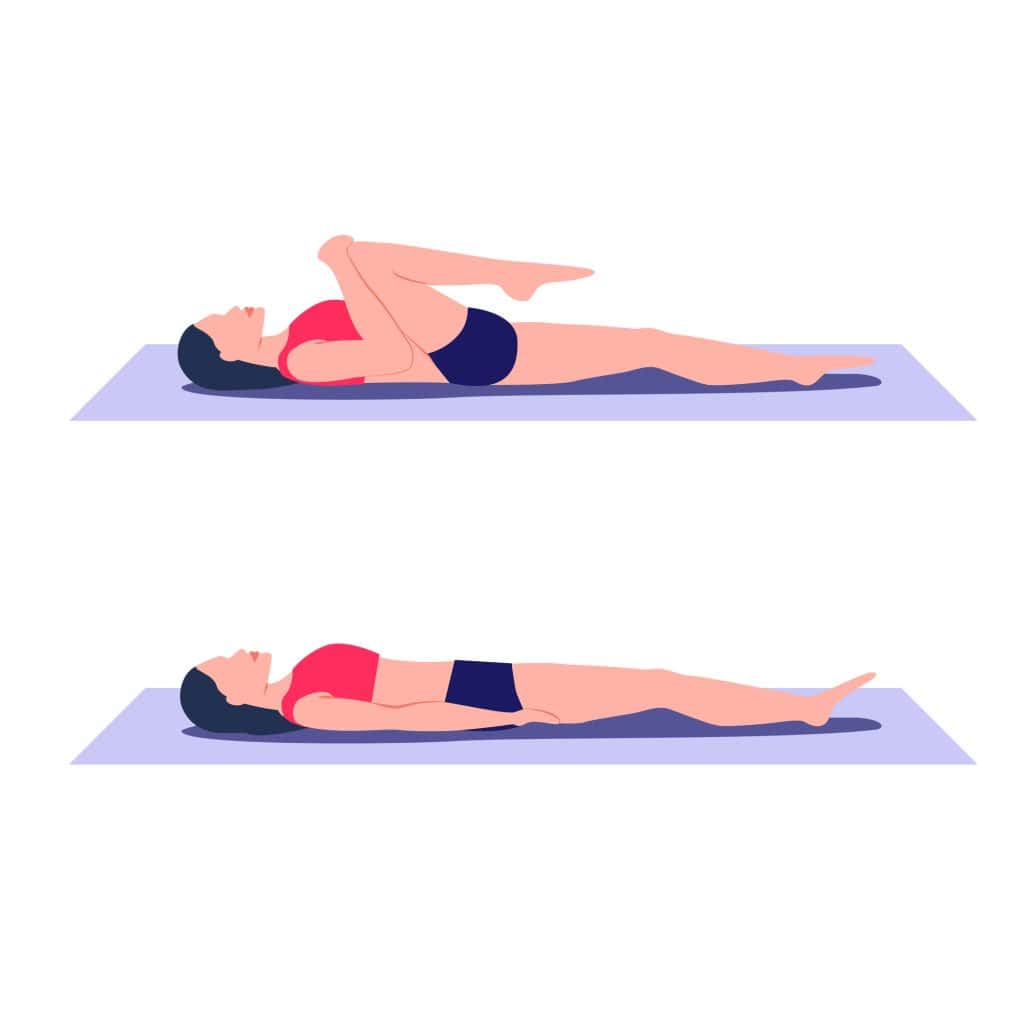
- Lie on your back on the floor.
- Bring one knee toward your chest and hold your knee or shin. Pull it in until you feel a comfortable stretch in your lower back.[3][4]
- Tighten your stomach muscles and press your spine into the floor. Hold for 5 seconds.[3]
- Switch legs, then pull both knees in together.[3]
Hold and repeat: 5 seconds per position. The American Academy of Orthopaedic Surgeons (AAOS) program repeats the sequence 10 times, for 3 sets, daily.[3]
Another way: Berkshire Healthcare’s version pulls both knees in together while holding behind your thighs.[4]
2. Knee rolls (lower back rotation)
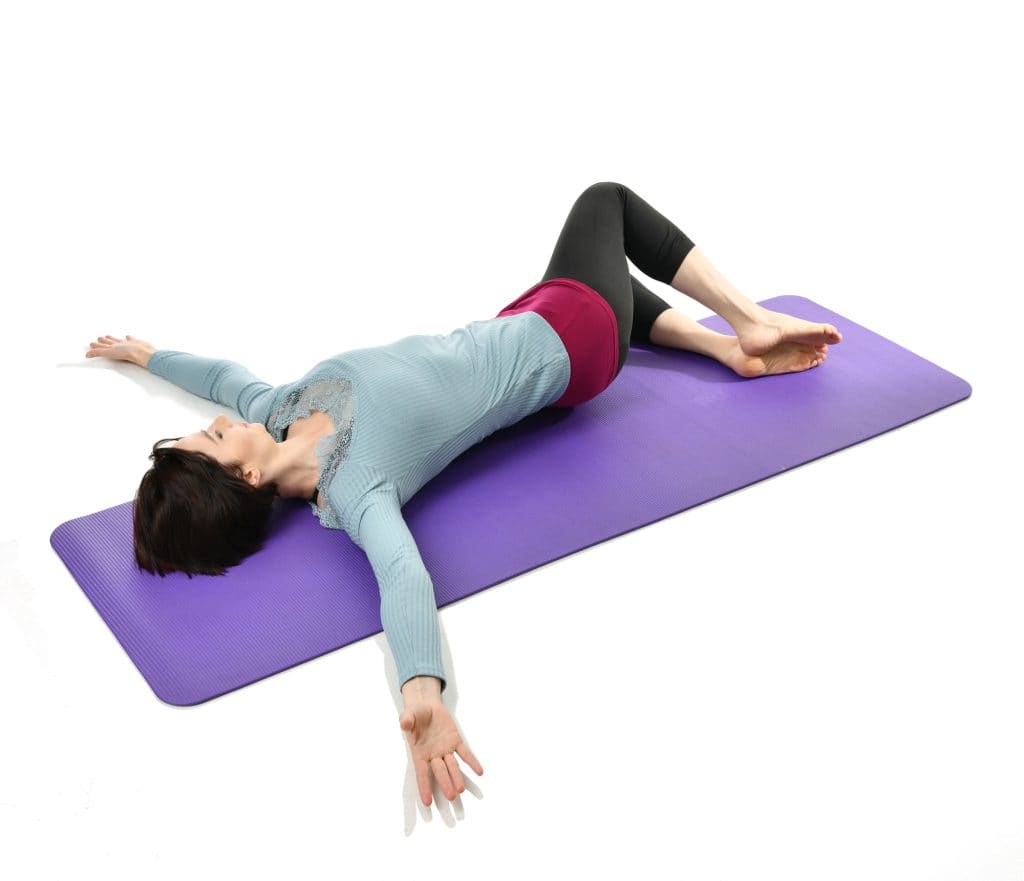
- Lie on your back with your knees bent and feet on the floor. Put your arms out to the sides for support.[4]
- Keeping your knees together, slowly let them roll to one side until you feel a gentle stretch. Keep your upper body still.[4][7]
- Bring them back to the middle, then roll to the other side.[4]
Hold and repeat: no set hold. Berkshire Healthcare’s physical therapy sheet suggests up to 20 repeats, twice a day.[4]
3. Pelvic tilt
- Lie on your back with your knees bent.[7]
- Gently flatten your back into the floor by tilting your pelvis back and curling your tailbone up.[7]
- Then gently arch your back away from the floor by tilting your pelvis forward.[7]
Hold and repeat: the hospital handout this comes from leaves the number blank for your physical therapist to fill in.[7] Until then, do it gently, as the handout describes.[7]
4. Kneeling rock-back stretch
- Start on your hands and knees with your shoulders over your hands. Look down at the floor.[3]
- Rock forward onto your arms, round your shoulders and let your lower back drop toward the floor. Hold for 5 seconds.[3]
- Rock back and sit your bottom as close to your heels as is comfortable, with your arms stretched out in front. Hold for 5 seconds.[3]
Hold and repeat: 5 seconds each way, 10 times, daily.[3] The sit-back position is close to child’s pose in yoga.
Go easier if kneeling hurts your knees: skip this one and use the knee to chest stretch instead.
5. Press-up (lower back extension)
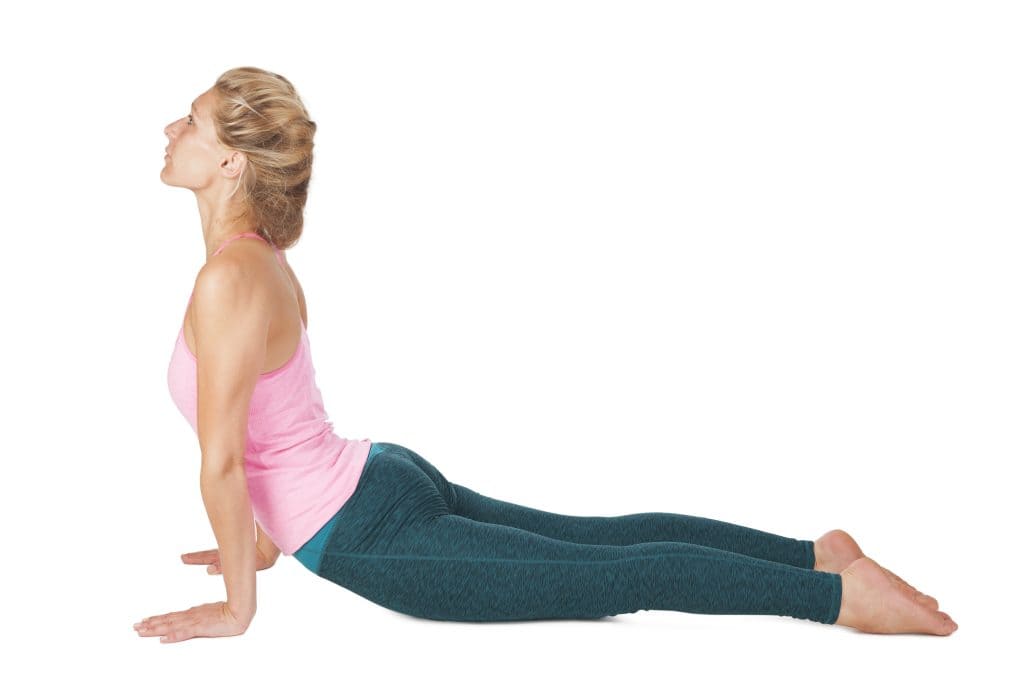
- On your forearms: lie face down, propped on your elbows and forearms. Let the small of your back arch gently and keep your forearms on the floor.[7]
- On your hands: lie face down with your hands under your shoulders. Straighten your elbows to lift your upper body as far as is comfortable, keeping your hips and legs relaxed on the floor.[7]
- Lower yourself back down slowly.
Hold and repeat: the source handout leaves this for your physical therapist to set.[7]
Go easier if it makes your back pain worse: stop, and ask your doctor or physical therapist before trying it again.[1][7]
6. Sitting rotation stretch
- Sit on the floor with both legs straight out in front of you. Bend one knee and cross that leg over the other.[3]
- Slowly twist toward the bent leg, with one hand on the floor behind you for support.[3]
- Rest your other arm against the outside of your bent thigh to help you turn a little further. Look over your shoulder.[3]
- Slowly come back to the center and switch sides.[3]
Hold and repeat: 30 seconds each side. Repeat the whole sequence 4 times, for 2 sets, daily. Sit tall throughout.[3]
7. Standing side bend
- Stand tall with your feet hip-width apart and your arms by your sides.[6]
- Slowly slide one hand down the side of your thigh as you bend sideways, only as far as is comfortable.[4][6]
- Come back to the middle and repeat on the other side.[4]
Hold and repeat: 2 seconds, 3 times each side. Build up the number slowly over time.[6]
8. Bridge (a strengthening move)
The bridge isn’t a stretch. It works the muscles of your lower back, buttocks and the backs of your thighs.[3]
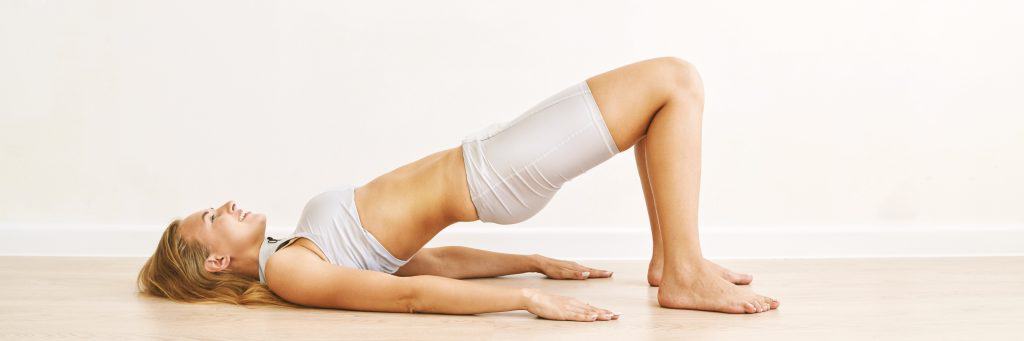
- Lie on your back with your arms at your sides, knees bent and feet flat on the floor.[3]
- Tighten your stomach and buttock muscles and lift your hips until your body is in a straight line from shoulders to knees.[3]
- Hold, then lower slowly. Keep your neck relaxed.[3]
Hold and repeat: 15 seconds, 5 times, daily.[3] For more moves like this, see low-impact strength building.
The 8 moves at a glance
| Move | Hold and repeat |
|---|---|
| Knee to chest | 5 seconds per position. Each leg, then both, 10 times; 3 sets.[3] |
| Knee rolls | No set hold. Up to 20 times, twice a day.[4] |
| Pelvic tilt | Not set in the handout. Ask your physical therapist.[7] |
| Kneeling rock-back | 5 seconds each way, 10 times.[3] |
| Press-up | Not set in the handout. Ask your physical therapist.[7] |
| Sitting rotation | 30 seconds each side. The whole sequence 4 times; 2 sets.[3] |
| Standing side bend | 2 seconds, 3 times each side.[6] |
| Bridge | 15 seconds, 5 times.[3] |
Pain in your leg too? Back pain that comes with leg pain can have a different cause, such as sciatica (a trapped nerve).[1][2] See our sciatica exercises and yoga for sciatica. For pain low on one side, near the dimples of your lower back, read about sacroiliac joint pain.
A short morning routine
If your back feels stiff when you get up, try this sequence from the list above. Skip any move that doesn’t feel right.
- Walk around for 5 to 10 minutes to warm up.[3]
- Knee to chest stretch, each leg and then both (stretch 1).
- Knee rolls, both sides (stretch 2).
- Pelvic tilts (stretch 3).
- Kneeling rock-back (stretch 4).
- Standing side bends to finish (stretch 7).
Sponsored · Back pain program
Want a routine you can start tonight?
Dr. Steve Young’s Back Pain Breakthrough is a short video series of gentle moves for lower back pain, including one you do in bed.
Moves to be careful with
- Anything that makes your pain worse. Stop that move and get advice.[1]
- Sit-ups, and leg lifts while lying on your stomach, while you’re recovering, unless your doctor or physical therapist says they’re OK.[8]
- Activities that involve heavy lifting or twisting your back for the first 6 weeks after the pain began.[2]
- Jogging, golf, racquet sports, contact sports and weight lifting while you’re recovering, unless your doctor or physical therapist says they’re OK.[8]
When stretching isn’t enough
If your back pain isn’t getting better after a few weeks of home care, see your doctor.[1] The American College of Physicians (ACP) advises starting with treatments that don’t involve medicine:[9]
- For back pain of less than 12 weeks: superficial heat (such as a heat wrap), massage, acupuncture or spinal manipulation.[9] See our guide to heat pads for back pain.
- For back pain that lasts longer: exercise, rehabilitation programs, acupuncture, mindfulness-based stress reduction, tai chi, yoga and motor control exercise, among others.[9] Read can yoga really relieve pain?
Evidence at a glance
| Question | What we found | Strength | Source |
|---|---|---|---|
| Does exercise help long-lasting back pain? | Yes. ACP lists exercise among the first treatments to try for back pain lasting over 12 weeks. | Moderate | [9] |
| Does heat help recent back pain? | Yes. ACP recommends superficial heat for back pain of less than 12 weeks. | Moderate | [9] |
| Should you rest in bed? | No. Health services advise staying as active as you can. | Not graded | [1][2] |
| Is one stretch best? | None of our sources names a single best stretch. They use different moves and numbers. | Not graded | [3][4][7] |
For a wider look at causes and treatment, see our back pain and lower back pain guide and 8 ways to manage back pain at home.
When back pain needs urgent help
Call 911 or go to the ER if you have back pain and:[1]
- a loss of feeling around your genitals or anus
- changes in your bladder or bowels, such as trouble peeing, or leaking pee or poop
- changes in how your genitals feel during sex, or new trouble getting an erection or reaching orgasm
- pain, tingling, weakness or numbness in both legs
- chest pain
- pain that started after a serious accident, such as a car crash
The first three can be signs of cauda equina syndrome, a problem with the nerves at the base of the spine that needs treatment right away.[5]
Contact your doctor right away if you have back pain with:[2]
- a fever you can’t explain
- pain traveling down your leg below the knee
- weakness or numbness in your buttocks, thigh, leg or pelvis, or trouble walking or keeping your balance
- pain that is worse when you lie down, or wakes you at night
- redness or swelling on your back
- burning when you pee, or blood in your pee
- a history of cancer, or pain after a hard blow or fall
- severe pain that won’t let you get comfortable
Also see your doctor if:[2]
- you’re losing weight you can’t explain
- you take steroids or inject drugs
Common questions
How often should you do lower back stretches?
Little and often.[4] The AAOS program runs daily for 4 to 6 weeks, then 2 to 3 days a week to keep your back strong and flexible.[3] Berkshire Healthcare’s physical therapy sheet suggests doing its exercises twice a day, morning and afternoon.[4]
What are the “big 3” exercises for lower back pain?
They’re three core exercises developed by spine researcher Dr. Stuart McGill: the curl-up, the side plank and the bird-dog.[10] They build core strength rather than stretch the back. In the curl-up you keep your hands under your lower back and lift your head and shoulders only slightly. A physical therapist at Spaulding Rehabilitation suggests doing them 2 or 3 days a week to start.[10]
Is walking good for lower back pain?
Yes, for most people. MedlinePlus suggests light activity such as walking, swimming or a stationary bike once the first 2 to 3 weeks have passed.[2] The NHS says walking, swimming, yoga and pilates may also help ease back pain.[1]
Sponsored · Back pain program
Ready for a guided back routine?
Get instant access to The Back Pain Breakthrough on any device, and see today’s price on the official site.
Official site · opens in a new tab
Free · From APM Health
Get our free morning movement routine
A short routine for easing a stiff back into the day. Sign up now and we’ll email it as soon as it’s ready.
- Free
- Sent as soon as it’s ready
- One email a week at most
Unsubscribe any time. Privacy policy
How we checked this article
Medical review: pending. A clinician hasn’t reviewed this article yet. We last checked it against the sources below on November 3, 2026.
Sources
- NHS. Back pain. Reviewed March 5, 2026.
- MedlinePlus. Low back pain: acute. Reviewed June 27, 2026.
- American Academy of Orthopaedic Surgeons, OrthoInfo. Spine conditioning program.
- Berkshire Healthcare NHS Foundation Trust. Physiotherapy advice for low back pain.
- American Association of Neurological Surgeons. Cauda equina syndrome. April 5, 2024.
- NHS. Flexibility exercises. Reviewed November 20, 2023.
- Cambridge University Hospitals NHS Foundation Trust. Back mobility exercises. Approved July 16, 2024.
- MedlinePlus. Taking care of your back at home. Reviewed July 23, 2024.
- Qaseem A, Wilt TJ, McLean RM, Forciea MA. Noninvasive treatments for acute, subacute, and chronic low back pain: a clinical practice guideline from the American College of Physicians. Annals of Internal Medicine. 2017;166(7):514-530. PubMed 28192789
- Harvard Health Publishing. Three moves for better spine health. August 1, 2020.